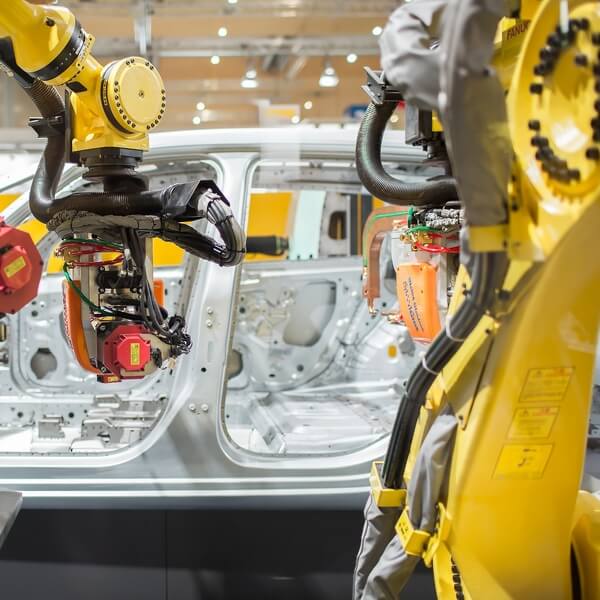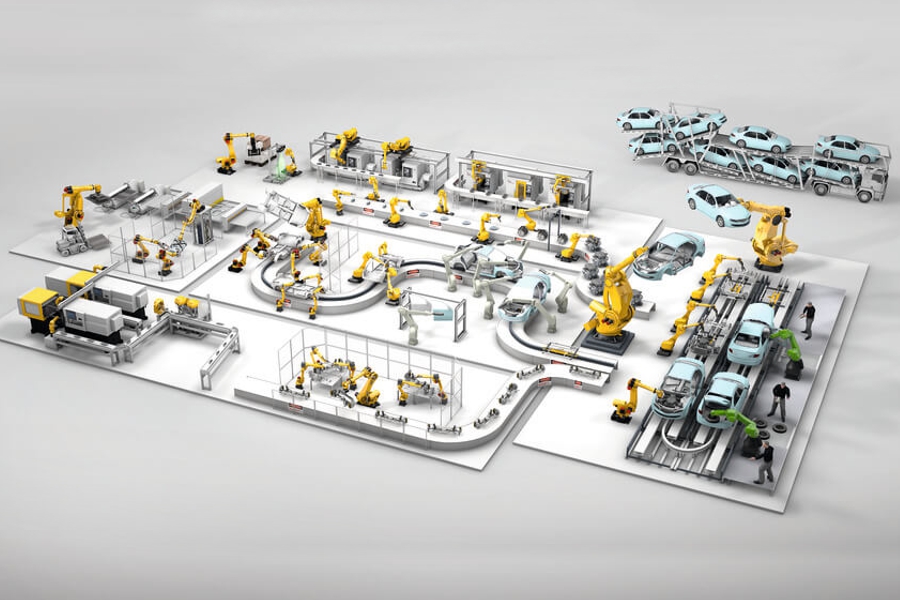

For decades, the automotive industry has been a frontrunner for automation and innovative technologies. This is the industry that introduced the world to smart factory solutions by deploying industrial robots throughout assembly lines.
Now, automation is essential to the post-pandemic recovery and the growth and progress of the automotive sector in a post-pandemic world, just as it was in the 2008 financial crisis. At the time General Motors, Ford, Fiat-Chrysler, and Tesla invested extensively in robotics and automation, which led to the creation of thousands of new jobs in the automotive industry. Many years later, car producers try to adapt to the “new normal” with all of its challenges while also trying to meet current market demands and prepare their strategies for the future. As the future, for passenger cars at least, is undoubtedly electric, manufacturers need more work power on their assembly lines, more flexibility and precision. And, they rely on robots and their expanding capacity to collect, interpret, and act upon reams of real-time data. At the same time, robots are becoming key in the EV production processes because automating the production process of battery cells is a high priority for vehicle manufacturers.
And this is a field where automation specialist and industrial robot manufacturer FANUC is leading the game. The company has produced over 750.000 industrial robots so far and is pursuing ambitious plans in Europe, where the robotics manufacturer is steadily expanding its sales, service network, and customer portfolio.
In 2021, the company received another major order in the field of e-mobility. Scheduled for delivery in 2022, the company will supply the Cologne plant of Ford with around 500 robots to assist in the construction of electric car bodies. The Ford manufacturing facility in Cologne is currently undergoing a transition into the Ford Cologne Electrification Center, a development and production site for electric vehicles that will serve the entire European market. In 2023, the carmaker expects its first purely electric high-volume passenger model to roll off the plant’s production line. Ford has also announced that it will only offer battery-electric passenger cars in Europe from 2030.
FANUC has been working closely with FORD in the US for many years and now is expanding its collaboration with the car manufacturer in Europe as well and its robots will contribute to low downtime and maintenance costs at Ford’s Cologne plant.
FANUC was also supplying BMW AG with 3.500 robots for new production lines and plants. FANUC robots will be used in the production of current and future generations of BMW models. The first robots were installed at the end of 2019. Furthermore, robots will be used at German and international production sites of the BMW Group in the coming years.
The automation trend in Eastern Europe
In Eastern European markets, the trend of automation is also catching up, driven mainly by the automotive and car components industries, but also to bridge the gap between labour supply and labour demand. And it is not just the automotive sector anymore; other industries such as food, pharma and logistics are quite active in this field. Countries such as Poland, Czech Republic, Slovakia and Hungary are already quite advanced in this field, while others, such as Romania are now also following the trend for automation and robotization.
“All around Europe, FANUC is an important player and a relevant supplier for all the major car manufacturers in the automotive industry. We have a consistent collaboration history and good growth perspectives in the market. All the trends that are recorded in the western part of Europe are shortly after being followed by similar measures in our region, especially considering the numerous OEM factories located in CEE. We expect the effects of the e-mobility to follow the same course,” says Tamas Mezei, Managing Director FANUC Automation Romania regarding the subject of e-mobility and how this is changing the demand for robotics solutions.
He says that FANUC is prepared to meet the requirements of the fast-developing digitalization in manufacturing, also automotive manufacturing, with a wide range of products and services. Not only does the company provides modern and innovative automation solutions, but FANUC also created an IoT platform that are able to connect all the equipment under the same roof, regardless of brand or being an older generation model.
“This is a unique FANUC feature that we provide to our customers, and they can control and fully own their data, either located on-site or on an external cloud. This is a very valuable thing to have in the automotive industry today, resulting in enhanced productivity and security. The automotive industry has always been a focus for us in Romania, and we continue to invest in it with dedicated products, customized client support and training. Still, we cannot avoid mentioning other industries that are growing considerably, such as the ceramic production industry, where we are witnessing successful expansion with record sales. We have a nucleus of important manufacturers in Alba-Iulia which are making their mark on the European business figures,” states Tamas Mezei.