
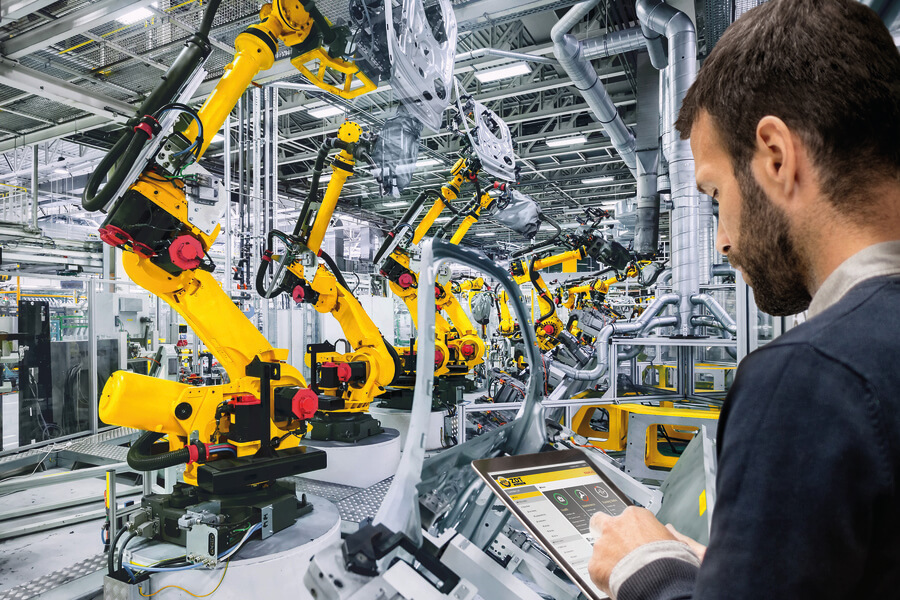
Automation is deeply ingrained in the automotive world DNA, the industry being at the forefront of innovation in this regard. Long before other industries were regarding automation as a way to increase productivity, car manufacturers were using industrial robots and sensor technology in their production sites.
Nowadays, technological advancements, combined with labour shortages in manufacturing are just two drivers for automation, and smart factories, where automotive is once again a frontrunner. Moving along with its customers in all manufacturing industries is the FANUC. Having first pioneered the concept of numerical control (NC), the Japanese company is today a leading global manufacturer of factory automation, with a product portfolio ranging from industrial and collaborative robots, to CNC controls, production machinery and IoT solutions. And, perhaps more impressive is that FANUC is walking the walk, meaning that for almost 50 years the company has been automating and robotising its own factories. “All FANUC factories are highly automated. As a supplier of automation and robotics we have always strived to fully utilise our own products in our factories. Our motivation is to prove the capability and benefit of FANUC products on the factory floor. We feed all of this information back into our product development, leading to continuous improvements. Today, we are using more than 4.000 robots in our own factories. These robots run 24/7 and complete a variety of tasks. For example, at one of our factories, robots are assembling new robots. We are probably the only robot supplier that is fully utilising its own robots as part of its production”, FANUC Europe President & CEO Shinichi Tanzawa said in an interview.
Cobots immersing into the automotive world
Automation is already very well established in the automotive industry, but OEMs, tier one, two and three suppliers alike can still profit from the advances in this field. Collaborative robots are the next step for the industry, as they offer a more flexible, lightweight alternative to traditional industrial-grade robots. They require a smaller footprint on the manufacturing floor, making them easier to integrate into existing structures. Beyond optimizing space, these robots can reduce costs associated with making modifications on the manufacturing lines. With a line-up of 11 cobot models ranging from 4 kg to 35 kg payload, FANUC has a clear objective set to mind: to become the clear market leader for collaborative robots in Europe. Due to FANUC’s almost 50 years’ experience in building industrial robots, CRX models work reliably and accurately under tough conditions, providing manufacturers with the highest possible production uptime. In fact, its CRX series is designed to work maintenance-free for eight years. “The CRX has enjoyed widespread adoption, especially in the arc-welding segment. Since the beginning of 2022, around a third of all newly sold CRX cobots have found use in arcwelding applications, largely because of the easy manualguided teaching and drag and drop functions, as well as FANUC’s tried and trusted ArcTool software that provides high levels of integrated welding functionality without requiring any customer development. Apart from arc welding, we see many other applications for our CRX series, from the assembly of small parts to the handling and palletising of large components and countless more”, said Shinichi Tanzawa.
IoT – the solution for manufacturing efficiency
Using IoT solutions in manufacturing quickly leads to higher production efficiency. As a result, FANUC developed MTLinki and ZDT (Zero Down Time). These two IoT solutions connect machines in the factory by collecting, managing and making various details about the machines visible and eliminating unforeseen production stoppages and enhancing FANUC robots and machines’ performance. FANUC combines automation with advanced analytics to drive smarter, faster business decisions for industrial companies, regardless of their size. The offer includes scalable IoT products that increase manufacturing efficiency through better production quality, performance, uptime and OEE. Production processes are made more efficient thanks to IoT solutions from FANUC.
FANUC Worldwide
• 5.2 million CNC controls
• Almost 1 million robots installed
Benefits of FANUC industrial IoT solutions
- performance improvement: collecting real-time data and transforming it into very useful business information
- cost reduction: reduce production costs and improve profitability by processing analysis and optimization
- quality improvement: data driven quality improvement impacts profitability
- process stability: monitoring and analysis of production data supports greater repeatability and brings stability
- uptime improvement: detect anomalies and receive notifications in advance to eliminate unplanned production stoppages
- traceability: record the process parameters and provide transparency in production regarding process condition, quality and materials used
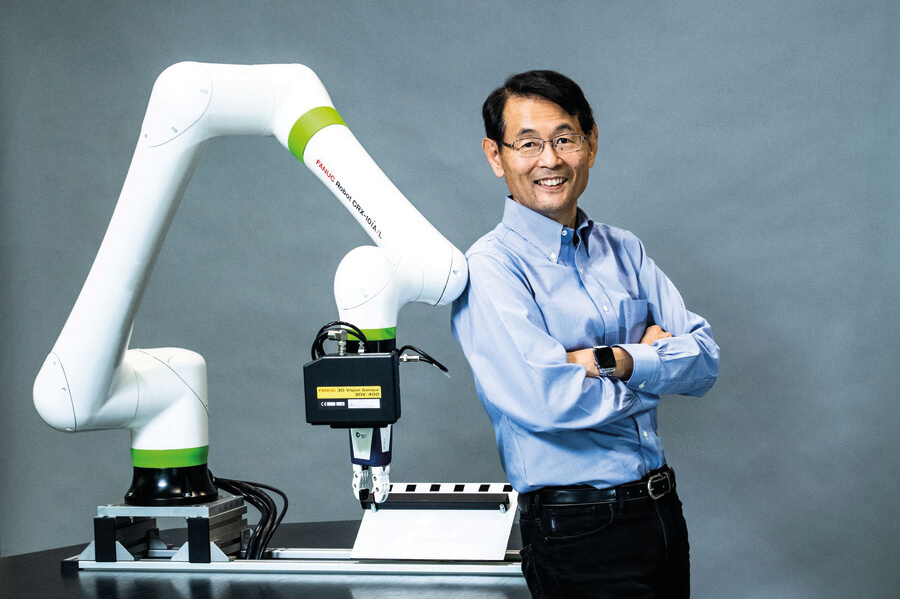
Shinichi Tanzawa, FANUC Europe President & CEO “Our experience of using FANUC equipment to automate our factories is applicable in all manufacturing sectors. The extent to which factories worldwide have adopted automation to date may be different, but it is clear that demand for automation will continue.”
Service first
provides customers with a single source for aftersales support and lifetime maintenance for its products as long as they are used by customers. The company provides the service of repair products that were manufactured more than 40 years ago. In 2022, for example, FANUC Europe achieved a spare parts availability of 99.98% while the average processing time for customer service requests within Europe was less than 26 hours (time between initial customer call and completion of service intervention).