
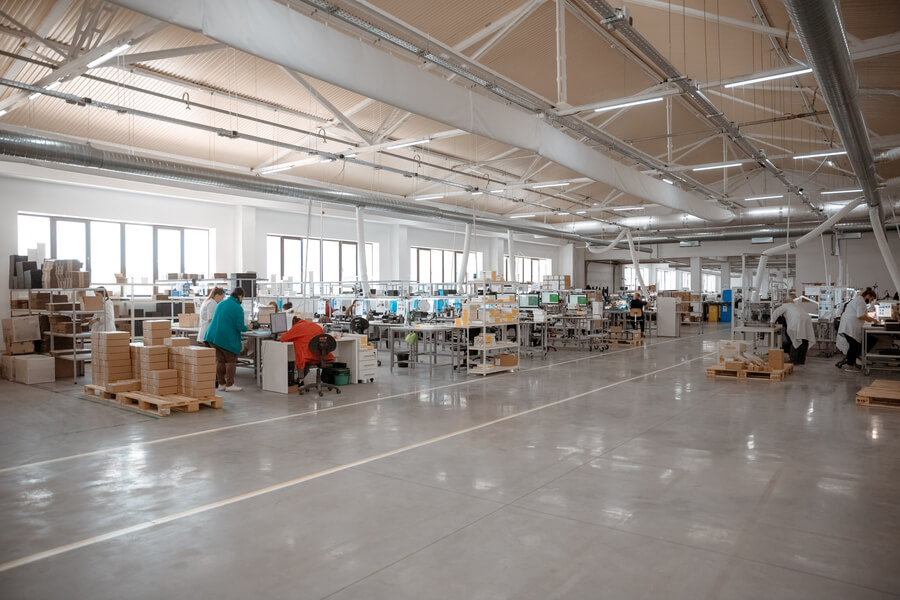
Plans for the first Magnetec factory in Moldova were at their final stage when the first pandemic lockdowns were being instated around the world, in March 2020. It was a crucial moment of doubt if the plans should be put on undefined hold or if the company should adhere to its initial plan and launch the factory.
The local management team in Moldova convinced the group’s management team in Germany that they would face every challenge the uncertain future may bring. And on April 13th 2020, Magnetec Moldova was officially opened. But with a significantly reduced pace in the first weeks, initial plans to achieve a staff of 150-180 employees in 12 months seemed fogged at that time.
Launching production in times of corona
Magnetec Moldova was created as a part of Magnetec group, linked to Magnetec factory in Hungary, which has operated since 1989. Thus, the first products to be manufactured in Moldova were transferred from the Hungarian factory and operation of the new factory began amid the most uncertain context.
First, groups of employees began learning their processes in manufacturing. And just like in the Elon Musk anecdote, the local management team almost slept on the factory floor, being side by side with the operational workers on the assembly lines in both shifts the factory operates, equaling to 16 hours a day. But those efforts paid off very fast. Workers acquired their skills fast and became independent, being a part of a smooth and efficient manufacturing process. And the pandemic has made people around the globe reconsider means of transportation and put an even stronger accent on zero-emission mobility. So electric cars became the new normal, not only in corporate communications but in actual sales. That played an unexpected role in Magnetec’s growth in Moldova.
Fast forwarding to the current day, 18 months after the launch, Magnetec’s factory staff in Moldova accounts for 309 people in manufacturing processes and 360 in total. And, as Magnetec’s group CEO, Marc Nicolaudius, said, the plan is to reach the 1,000 mark in terms of employee count in the next 3 years. So, the million-dollar question here is, what exactly does Magnetec manufacture in Moldova?
Made in Moldova for a broad range of applications
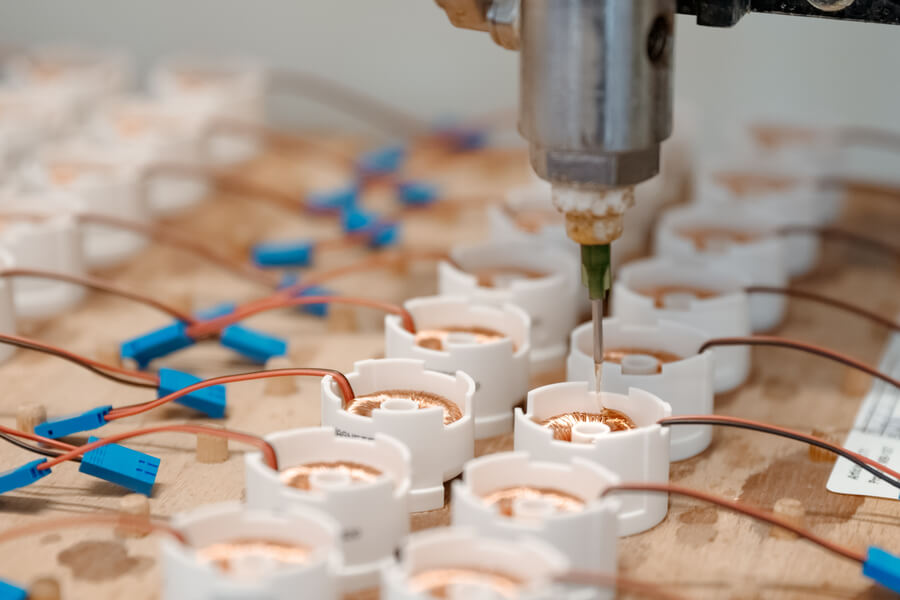
Well, the main components are a variety of toroidal inductors and transformers with hi-tech cores that make them highly efficient in modern high-density electric and electronic components. The largest ones produced here go into wind turbines that generate electricity. The smallest of them go into chargers of electronic products. And even more intriguing, medium-sized inductors and transformers become part of high-power superchargers for electric cars! EV superchargers, for instance, contain several types of toroidal inductors made at Magnetec Moldova! And similar components also become a part of other fast chargers as part of electric mobility infrastructure. Some of them are installed in private home wall boxes for electric cars. The main idea is simple – wherever there are high-powered, performant electric car chargers, there is a high chance that they have crucial parts sourced from Magnetec and very likely made in Moldova, since those types of inductors are directed to this factory in the Magnetec group. But the application of the toroidal inductors is even broader than electric cars, electric device chargers, or wind turbines. Hundreds more electric devices use those types of elements, and Moldova’s products also end up in a large variety of Siemens devices, in electric grid safety boxes, and many more other.
The largest part of the inductors is made on automated assembly lines, but more specific toroidal inductors need a great deal of skilled manual work. In both cases, the whole assembly process is a smooth and precise flow of events, with mandatory testing and quality controls at the end. At its final stage of packaging, the components are photographed with a specially mounted high-res camera, and the image is stored with the package number and tracking details.
Arguments for investing in Moldova
Magnetec Moldova operates with a local management team. Igor Munteanu and Veaceslav Bejenaru are the two local managers. Both live in the same city of Bălți, where the factory is located, both have previous experience in factories producing automotive components and have made their way from the entry-level hierarchy of operators. That is precisely what gives them a complete understanding of all the processes in such a facility. You would perhaps wonder how the story of investing in Moldova is viewed by the Magnetec group CEO, after 18 months of experience and what would be the feedback from the perspective of the person who took part in the decision-making and keeps strong contact with the company’s shareholder.
In an online conference, we had the opportunity to speak directly with Mr Marc Nicolaudius, Magnetec’s group CEO, and find out his perspective.
Why was Moldova chosen in the first place? Well, they found the status of Free Economic Zones (FEZ) to be especially attractive and found immediate support from administrators of the Bălți industrial park managing the regional FEZ. As Mr Nicolaudius told us, all open questions could be answered, and they found great support in finding a location and staff, with excellent efficiency and rapid communication. There were more analysis points, though, a grid of about 30.
The labour costs are not the lowest, and you can find countries with lower costs. But other factors proved to be much more convincing: an attractive tax scheme, geographical proximity, and an excellent local management team, attracting skilled staff.
Logistics would typically be a setback since Moldova is not a part of the EU, but the Free Economic Zone status made in possible to overcome that. That takes off bureaucracy and ensures speed and predictability in logistics.
Mr Nicolaudius assesses that this status plays a crucial role in attracting such investments, and it constantly proves to be of utmost help in their business. After 18 months of operating experience of Magnetec’s company in Moldova, with such growth achieved, Mr Nicolaudius has stated firmly: Moldova was the most attractive country for them to invest in. Now that attractiveness seems even more fortified and grounded. There are things to be improved, of course, especially on the part of a more modern and advanced education, and Magnetec Moldova has initiated a program to partner with local universities to support that development. To be correctly understood, says Magnetec’s CEO – the current situation is not in bad shape. Still, future requirements are getting higher, and we need to think and act now to prepare future engineers to address those requirements. That also comes as a result that Magnetec Moldova’s factory plays crucial in the electric mobility area of the group business and now the most important part of the growth comes from this area thanks to the growth of electric vehicles and the transition to electric mobility. And that means a large part of business growth for the group will directly link to the growth of the Moldovan facilities. While the factory started with existing products, transferred from the assembly line in Hungary, now the new products are being developed and put into production directly in Moldova, raising the demands from the engineering team there. And the management team is now already prospecting the expand the existing facilities. Thus, Magnetec’s story in Moldova proved to be one of daring to invest in the most uncertain time and benefitting far more than anyone expected from the global change in demand. More electric cars around the world, more electric charging infrastructure, more green energy and emission-free means of transportation mean a higher demand for the vast part of the company’s portfolio of products and envisioned future products. And since that demand is expected to grow decades ahead, Magnetec is prospecting even more global expansion.
That status allows a company to source its raw materials without actually importing them, to process them in manufacturing and to export the final products on a fast track without normal exporting procedures since all the components were not wholly imported in the first place.