
Yes, there is no mistake in the title. All the Porsche 911 versions of the current generation, from Carrera S to Targa, Turbo of even GT3, delivered in all markets worldwide, have their seat covers made in the city of Ungheni, in Moldova, at Lear Corporation’s facilities there.
The same all-versions and all-markets principle are applied to Porsche Taycan, so if you see anywhere in the world a Taycan, there are 100% chances that the seat covers are made at the same factory in Ungheni. And exactly the same is true for the new Audi e-tron GT. In the case of Mercedes models, the number of models and units produced is much higher, so there are many more Lear Corporation plants worldwide producing seat covers for them. But the factory in Ungheni has a long tradition of manufacturing for Mercedes, starting with the C-Class W204, then all the W205 family, including AMG models, and now the new C-Class W206. The same factory manufactures seat covers for the GLC SUV and GLC Coupe family, the SL and SLC, the electric EQC and even the sporty Mercedes-AMG GT.
Each day, the Lear factory in Ungheni can manufacture up to 2,100 sets of seat covers for 2,100 cars. That means delivering sets of seat covers for 40,000-45,000 vehicles per month and about half a million cars per year! That gives us a brief picture of one of the largest automotive factories in Moldova, belonging to an international network of manufacturing locations of one of the largest global companies of its kind.
The annual turnover of this single Lear Corporation factory in Moldova is more than 100 million USD, so there is a great ever-evolving story behind the gates of Lear Corporation in Ungheni. A story of large-scale success in Moldova for a global leader. We were granted full access to the manufacturing lines and the entire production process to find it out from the inside. Lear Corporation launched their investment in Moldova in 2010, in the building of an old, defunct factory, of 6,000 sq. meters, on 4 floors, which went through a complete refurbishment, being equipped with all the modern machinery you could find at other Lear factories around the world back then. After 11 years of growth, they have an entire complex of buildings totalling 18,000 sq. meters. There are more assembly lines now and even complete departments divided by stores, sewing for Porsches on one floor, for Audi on another floor, and for Mercedes on the other ones. And, of course, there are unified parts of the process that are made under one single roof, especially the initial parts of production, when the leather is analyzed, cut and pressed for later sewing. The leather and textiles that go into final seat covers are mainly sourced from well-known European suppliers and based on customer (OEM) design and preferences.
Raw materials are delivered to Lear’s warehouse with minimal import bureaucracy. That’s because Lear Corporation in Ungheni is also using the crucial advantages of the Free Economic Zones in Moldova, gaining speed and predictability in logistics and avoiding bureaucracy.
The raw material is inspected automatically and manually with the trained human eye. Should any slight imperfection be found, a corresponding mark will be made. Then, when the inspected roll is laid onto further automatic scanning, those marks help the algorithms calculate the best use of that piece of leather to cut the most, with minimal losses, while ensuring the outstanding quality of the final product.
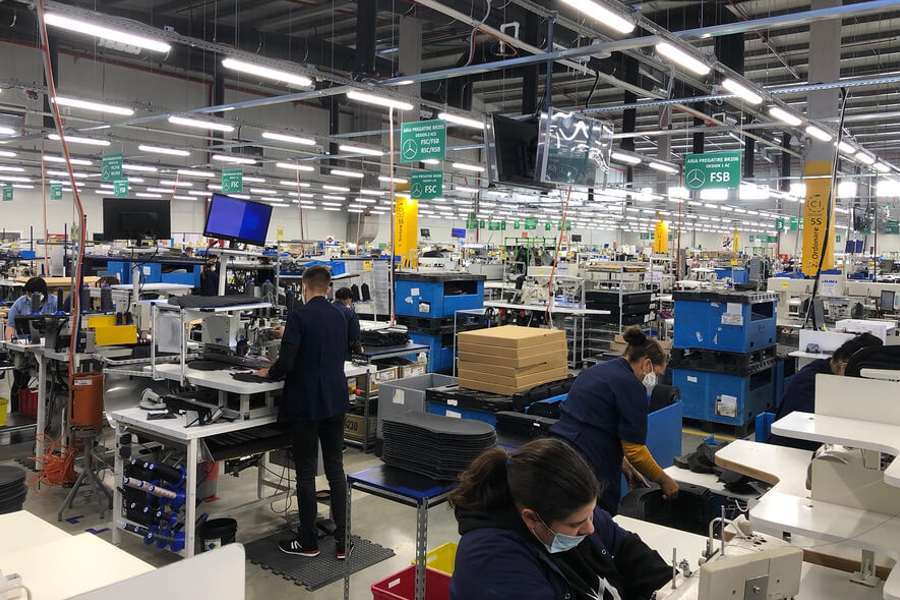
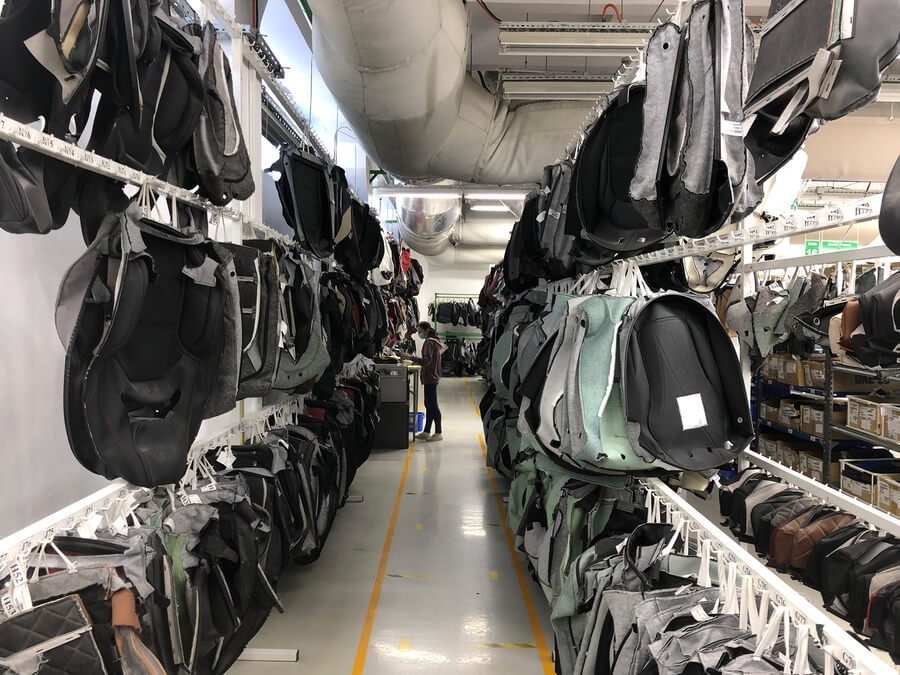
Depending on the model and requirements, the leather can be thermolaminated, embossed or stitched with inscriptions and logos to have the basic shapes for the future seat cover, and all this is done under strict quality control. These processes have been made under the same roof for all brands and models. After that, the prepared pieces of leather and textile go to the right department, specialized by brand and model. A process containing manipulating automatized sewers is dominant, but some models require more manual, highly skilled labour, which is marvellously learnt and owned here. Sets of pieces go to different assembly lines, and at the end, complete seat covers are packed according to packaging instructions. And you can see covers made of any modern material used on the newest models – man-made leather, textile, Alcantara, natural Nappa leather or even newer eco-leather used on some electric cars.
More than 2,000 people work at Lear Corporation in Ungheni, in three shifts. The last expansion was made in 2020, during the first months of international lockdowns.
The factory has contracted small busses regularly to drive to predefined routes, providing free transportation for employees to their workplace and back home. People from a radius of up to 45 km come to work here. And being in constant expansion, Lear’s Ungheni General Manager, Mr Marian Lefter, says they need more qualified people. But there is also a Training Area in the factory, which prepares the newly employed people for the future processes on the assembly line. So, they learn everything in a controlled environment, with test machinery and test raw materials, acquiring the needed knowledge and skill before being a part of the assembly line.
Decent wages, decent work conditions, alimentation on location, and even a medical centre on the place are part of the factory’s culture of making employees feel well treated, respected, and motivated to give their best to the products they manufacture. You can see images of Porsche 911 on the wall, images of Audi e-tron or of Mercedes models, as a matter of inspiration for their work.
Of course, the chip shortage is affecting the factory workload, as everywhere around the globe, mainly due to projects put on hold or to longer delivery times for the final cars which means unoccupied current capacity sometimes. But, anyway, large trucks of final sets are loaded each day and hit the road to their next location in Germany or elsewhere, and chairs of finals cars are manufactured. And despite the chip shortage, the Lear factory in Ungheni is on the growth path. The newest projects of electric cars like Porsche Taycan and Audi e-tron GT prove that this precise factory in Moldova is on the very best traction you can dream of for future development, being a part of the shift in mobility preferences around the globe. And for Moldova and the communities in Ungheni, the story of Lear’s large-scale success is also a story of their success and pride for what more than 2,000 people are working at daily, being a part of the global automotive industry, working at the most demanding quality standards, and delivering to top manufacturers around the globe, including for some of the most dreamt of legendary car models, being produced nowadays!
Lear in Moldova
- 100-million-euro annual turnover
- 18.000 sqm of production
- 2.000 employees
- 2,100 sets of seat covers for
- 2,100 cars – daily production capacity