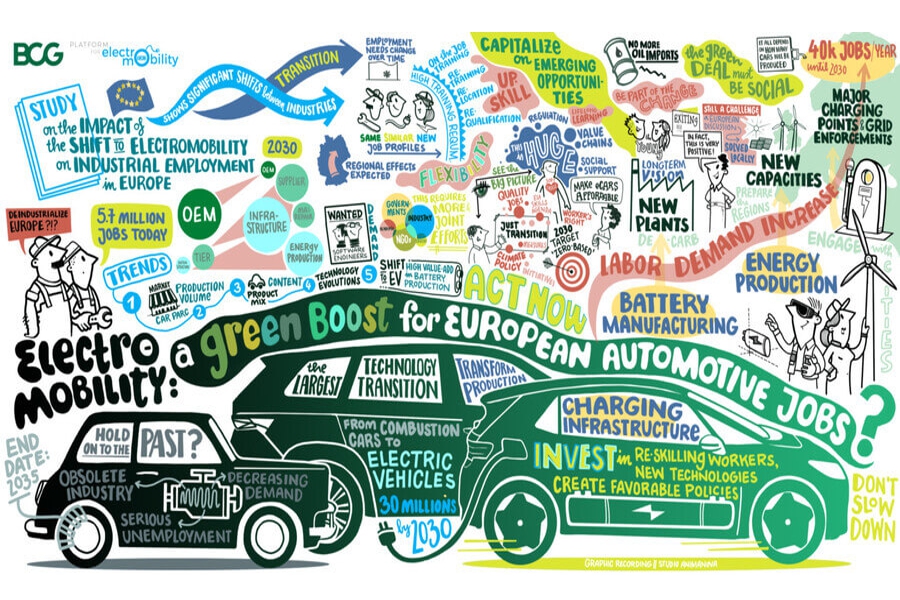

The Platform for electromobility has facilitated a report by the Boston Consulting Group – on the impact of the shift to electric vehicles production on automotive jobs in Europe. The Platform for electromobility represents 45 organisations from industry, civil society and cities that employ around 650,000 people globally.
The study takes a deep dive into the potential opportunities and challenges created by the automotive industry’s transformation in the coming ten years. Key findings: a comprehensive and inevitable transformation The automotive sector was deeply impacted by the COVID-19 crisis and will likely need several years to reach pre-pandemic levels of production and profitability. Prior to the pandemic, manufacturers were producing approximately 17.7 million light vehicles in Europe with an overall production value of about €700 billion.
The study shows that the industry will rebound with a shift from internal combustion engines (ICEs) to electric vehicles (EVs). Alongside electrification, digitalisation will be the second pillar underpinning the carmakers’ recovery: the study projects that the value of software in cars will increase by 11% each year.
Based on the projected production and sales volumes for 2030, the study concludes that – across the 26 industries within the scope of the research, which represent 5.7 million jobs – overall employment is forecast to remain essentially stable compared to the 2019 baseline, with minimal variations in job numbers. Although electrification will partly contribute to these slight variations, the study predicts that EVs will have only a minor net impact on jobs through 2030, contrary to what some observers expect. However, this relatively small net figure should not obscure the massive structural changes resulting from the shift to electrification.
Changes in production will modify both the skills requirements and the distribution of labour. Overall, the effects on employment in the core automotive sectors caused by the product changes arising from the EV shift will be compensated for by new opportunities created by the electromobility ecosystem. These will be driven, for example, by growth in battery production and charging infrastructure. The study mentions that a failure to electrify would likely lead to competitive disadvantages and subsequent significant job losses across European industry.
The need for a robust framework to master the transition
The transition to electromobility does not pose a threat but rather an upskilling opportunity for workers. With the correct political and regulatory choices, the outlook is positive for one of Europe’s strategic industries and workforce. The EU, governments and companies should prioritise programmes that invest in the education, training, upskilling and reskilling of the labour force to capitalise on new opportunities, raising the bar on employment conditions, to ensure no one is left behind.
- European Institutions: Workers in the automotive sector should benefit from a policy framework similar to that already flourishing in the energy-intensive industries, thanks to the Just Transition Fund, Just Transition Platform and Just Transition Mechanism.
- Industrial stakeholders: For employers – notably carmakers – support will be needed to design requalification and upskilling programs and hiring and restructuring programs. Battery manufacturing and infrastructure deployment for distribution via charging stations and production via renewable energy will be the core job providers during this transition. Support should be provided for small- and medium-sized enterprises during the transitions, as they will lack more prominent companies’ analytics and training resources.
- Local and regional authorities: According to the study, relocations should be avoided where possible by adapting existing production plants and training for new skills where they are needed. Local and regional authorities will play a key role in addressing the knowledge gaps in the workforce for EV production and the whole EV system and value chain.

- By 2030, some 59% of European sales will come from electric vehicles (70% if plug-in hybrids are included).
- Until 2030, direct employment in carmakers and ICE-focused suppliers will decrease by 5%.
- Adjacent industries’ workforce – such as those in energy production and charging infrastructure – will increase by 34%.
- The shift will create more than 580,000 new jobs – the production of EV vehicles will be the primary driver for job creation.
- A further 40,000 will be created each year by construction and civil works for adapting energy production and distribution infrastructures
- By 2030, 2.8 million workers will need to be hired, and the job profile of 2.4 million positions will change, with different degrees of training needed to prepare them for future job demands, the study estimates
- 42% of all employees in the core automotive and adjacent industries will have dedicated training needs by the end of the decade
- 1.6 million will require retraining while remaining in their current position; another
- 610,000 will need requalification while remaining in the same industry cluster;
- 225,000 people will need support to requalify for work in other industries outside the automotive ecosystem.