
From demand planning, risk management, to supplier selection, artificial intelligence is reshaping the future of supply chains as companies grapple with the impact of geopolitical tensions and pressure to eliminate links to environmental and human rights abuses.
BMW, Unilever, Siemens and Maersk are just a few examples of companies that use artificial intelligence to negotiate contracts or find new suppliers. And the list is going to get even longer.
In this analysis we aim to show how artificial intelligence helps companies manage their supply chain, and how it could develop further in the future.
Although AI support in supply chain management has been in use for years, the development of so-called generative AI technology has provided more opportunities to further automate this process.
More and more corporations have been faced with the need to stay in touch with their suppliers and customers amidst disruptions during the Covid-19 pandemic as well as rising geopolitical tensions.
What is generative AI in supply chain?
Generative AI creates new content, such as images, text, audio, or video, based on data it has been trained on. While the technology isn’t new, recent advances make it simpler to use and realize value from, according to an EY report.
As investors pour cash into technology, executives are racing to determine the implications on operations, business models and to exploit the upside. “For those who diligently pursue innovation guided by strategy and an understanding of the limitations — not by an impulse to chase after the latest shiny object — generative AI can prove to be an agile co-advisor and multiplier in strengthening supply chains”, the EY report shows.
How can AI help redraw the supply chain map?
- The impact on demand forecasting
- Warehouse automation and management
- Quality control
AI’s Impact on demand forecasting and resilience
One of the key areas where AI is transforming supply chain management is demand forecasting and planning. AI is revolutionizing demand forecasting and planning in supply chain management, significantly impacting accuracy.
Kearney reports a 20% improvement in forecasting precision due to AI’s ability to handle fluctuating consumer demand and align production and inventory more accurately. This precision minimizes stock issues and reduces risks associated with inaccurate forecasts, establishing AI as a vital tool for efficient supply chain operations.
Also, AI-driven demand forecasting achieves a commendable 25% reduction in forecast errors. This reduction not only streamlines inventory management but also translates directly into significant cost savings.
In addition to enhancing forecasting, AI plays a pivotal role in boosting overall supply chain resilience by 15%. Real-time data and predictive analytics empower swift responses to disruptions, positioning AI as a strategic asset for navigating challenges effectively. This resilience not only safeguards against disruptions but also positions AI to capitalize on market opportunities in the dynamic automotive supply chain landscape.
AI’s influence extends to network optimization, covering the entire supply chain network, from purchasing and production to distribution.
Kearney emphasizes that AI enables the evaluation of various production network scenarios, helping draw recommendations for optimizing network design. This complex task involves determining optimal production facility locations, appropriate vehicle types for factories, and designing production flow and volume structures. The assistance of AI is crucial in simulating scenarios, modifying operating levers, and devising optimal recommendations for production and supply chain networks.
Furthermore, AI facilitates improved collaboration between supply chain partners by sharing demand forecast data with suppliers. This collaboration optimizes production schedules and delivery plans.
Additionally, AI enhances real-time supply chain visibility by integrating data from various sources, such as sensors, GPS, and IoT devices. This integration enables AI systems to provide real-time visibility into the supply chain, allowing businesses to identify disruptions and make data-driven decisions for optimized supply chain management.
Benefits of AI in forecasting operations according to Kearney
- 20% improvement in forecasting precision
- 25% reduction in forecast errors
- 15%boost of supply chain resilience
The use of AI in warehouse automation and management
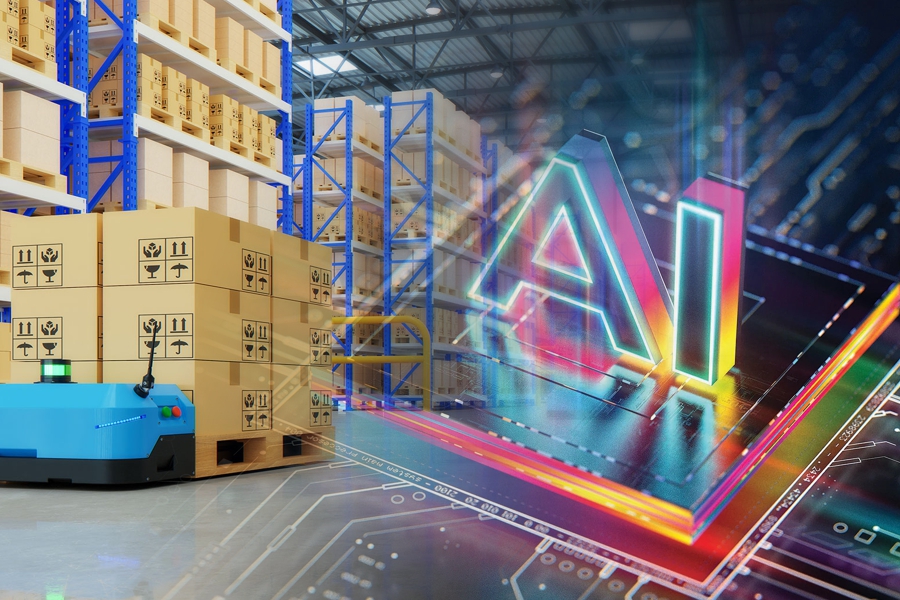
AI’s integration into warehouse automation is reshaping supply chain and logistics operations. Robots equipped with AI, including machine learning, computer vision, and sensor fusion, are increasingly automating tasks such as picking, packing, and replenishing. Autonomous mobile robots (AMRs) operate independently, adjusting to changing warehouse configurations and operational demands. In collaborative environments with human workers, this synergy allows for a division of labor, with AI handling repetitive tasks and humans focusing on more complex responsibilities. Such partnerships hold the potential to maximize workforce productivity and enhance overall warehouse efficiency in supply chain and logistics.
AI extends its transformative impact beyond automation to streamline procurement processes and enhance customer service. Real-time tracking of orders, facilitated by AI, offers customers transparency and peace of mind regarding the status and location of their shipments. Additionally, AI-driven natural language processing (NLP) automates customer service tasks, such as answering FAQs, freeing human representatives to concentrate on more intricate matters. These AI capabilities not only improve response times to customer inquiries but also contribute to greater overall customer satisfaction.
In the realm of warehouse management, AI continues to drive efficiency by automating tasks such as inventory tracking, picking, and packing. AI algorithms optimize warehouse layouts, enhance routing efficiency, and minimize errors, leading to increased productivity and cost savings.
Through its multifaceted applications, AI is revolutionizing the landscape of supply chain and logistics operations, bringing about improved processes, enhanced customer service, and streamlined warehouse management.
How artificial intelligence helps in quality control
The integration of AI-enabled sensors and analytics tools has revolutionized quality control in supply chains and logistics. AI continuously monitors product quality, swiftly detecting defects in real-time, ensuring products meet the highest standards before reaching customers. Various sensors, designed to identify imperfections and programmed to scrutinize for errors, play a crucial role. Predictive maintenance AI models assess product usage, generating recommended maintenance schedules based on extensive trends.
In transportation, AI-enabled sensors, particularly Internet-of-Things (IoT) sensors powered by AI, monitor product conditions. For instance, these sensors can detect changes in temperature and humidity, ensuring perishable goods are maintained at the correct temperature during transportation. The widespread adoption of AI-enabled sensors empowers businesses to deliver only top-tier products, enhancing customer satisfaction and safeguarding brand reputations.
AI’s real-time data processing and analysis capabilities are transformative for predictive maintenance and quality control in the supply chain. Monitoring equipment performance and analyzing sensor data allows AI to predict maintenance needs, minimize downtime, and optimize production schedules. AI’s scrutiny of quality data identifies potential issues early, ensuring sustained product quality and minimizing wastage.
In summary, AI is transforming the entire supply chain, from automating workflows and predicting demand to providing real-time visibility, enabling businesses to optimize operations, enhance efficiency, and elevate customer satisfaction.
How will AI shape the future of supply chain in the next years to come
Companies are still interested in investing major resources in AI development for the supply chain. According to a Gartner report, 50%of supply chain organizations are projected to invest in AI and analytics applications through 2024. The beginning off using AI in supply chain started in 2020, because of the Covid-19 pandemic. That was the start for the major companies to learn that technology is growing and is a must in this age. According to the Garner report, the onset of the epidemic brought unprecedented challenges to supply chain organizations worldwide after the global health crisis disrupted economies, halted manufacturing, and led to erratic consumer behavior.
Adheer Bahulkar, global supply chain lead of Accenture’s consumer goods and industry practice, believes that because of the shift to digital commerce, companies need to adapt with new technologies to avoid being left behind. He predicts that in the next five to 10 years, artificial intelligence will play a major role in helping to fuel supply chain resilience.
In 10 years, supply chains could be highly autonomous, with AI-powered systems managing much of the process from procurement to delivery.
The circular economy concept could be adopted more widely, minimizing waste and maximizing resource efficiency.
„Successful consumer goods companies will be those that transform their supply chains into value networks, investing in transforming them for growth,” Bahulkar points out.
„This requires a move towards holistic physical and process automation, as well as the adoption of new business models, shared supply chains and strategic leveraging of the supply chain as a service where it makes sense.”