
In a successful cooperation between BMW Group Plant Dingolfing and Landshut University of Applied Sciences, students have developed an innovative solution for plant logistics. The new digital tool automates the counting of empty containers using artificial intelligence (AI), saving time and avoiding errors.
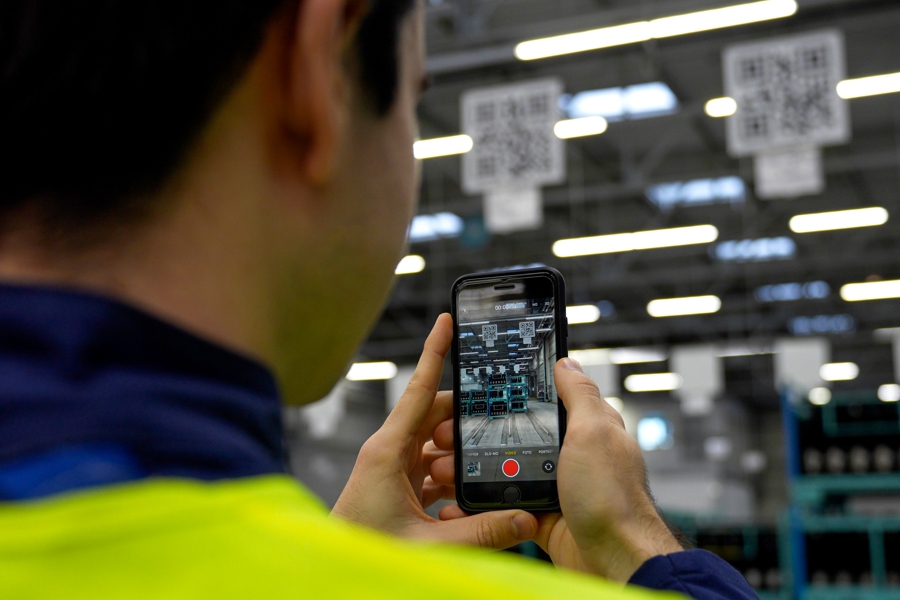
At the BMW Group Plant Dingolfing, around 1,600 different types of containers are in circulation every day, transporting parts for vehicle production. Now, a video of the containers taken on a mobile phone can be used to determine the exact number per container variant, due to QR codes placed above the block storage lanes which link to a database of container data. The AI analyses the video and calculates the number of containers in real-time.
The system is currently in the pilot phase to test its performance, but BMW hopes the solution will be scaled and used in other areas of plant logistics in the future. It is also planned to further automate the counting process by using autonomous Smart Transport Robots (STR) to record the videos.
“Our goal was to automate empties counting as efficiently and simply as possible,” explains Wolfgang Schratzenstaller, project manager at the BMW Group Plant in Dingolfing.
The idea of involving students from Landshut University of Applied Sciences in the project met with a positive response. “Students bring in new perspectives and unbiased approaches,” says Schratzenstaller. Prof. Dr. Abdelmajid Khelil, head of the IoT Innovation Lab at Landshut University, supported the project as part of a practical teaching module. The collaboration began with the summer semester 2024.
Mobile video instead of mental arithmetic
Within three months, the eight-person team developed a cost-effective and efficient solution. A simple mobile phone video, taken while running through the rows with the containers, is sufficient to determine the exact number per container variant. “QR codes are placed above the block storage lanes, which link to a database of container data. The AI analyses the video and calculates the number of containers,” explains Dominik Dama, an IT master’s student.
Many plants and facilities in the automotive supply chain face the problem of huge stacks of empty bins taking up valuable space. In some cases, plants keep more bins than necessary, leading to inefficiencies.
One way to combat this challenge is through the use of digital tools such as artificial intelligence (AI).